


October 28, 2026
AIL’s High-Performance Woven Geotextile helped address challenging ground conditions during the rehabilitation of Klondike Highway #2 in Yukon, providing reinforcement for roadway embankments constructed over deep muskeg deposits and areas of discontinuous permafrost.

The Yukon government undertook the 21.6 km highway improvement project between km 498.4 and km 520.0, south of Stewart Crossing and north of Pelly Crossing, within the traditional territories of the Selkirk First Nation and the First Nation of Na-Cho Nyäk Dun. Weak underlying soils along the highway corridor presented a risk of differential settlement, potentially affecting roadway stability, ride quality and long-term maintenance requirements.
To mitigate these challenges, Yukon Highways and Public Works incorporated geosynthetic reinforced soil (GRS) embankments at three locations along the corridor, covering a total length of 1,730 metres. AIL supplied the high-performance woven geotextile used to reinforce these embankments, with layers installed at 300 mm vertical intervals.
Installed across the full width of the embankments, the geotextile provides tensile reinforcement and confinement, helping distribute loads throughout the compacted soil structure. Working together, the geotextile and granular fill form a reinforced soil mass designed to improve stability and embankment performance over weak foundation soils. This approach offered a practical solution for addressing the settlement risks associated with the site’s challenging northern environment.
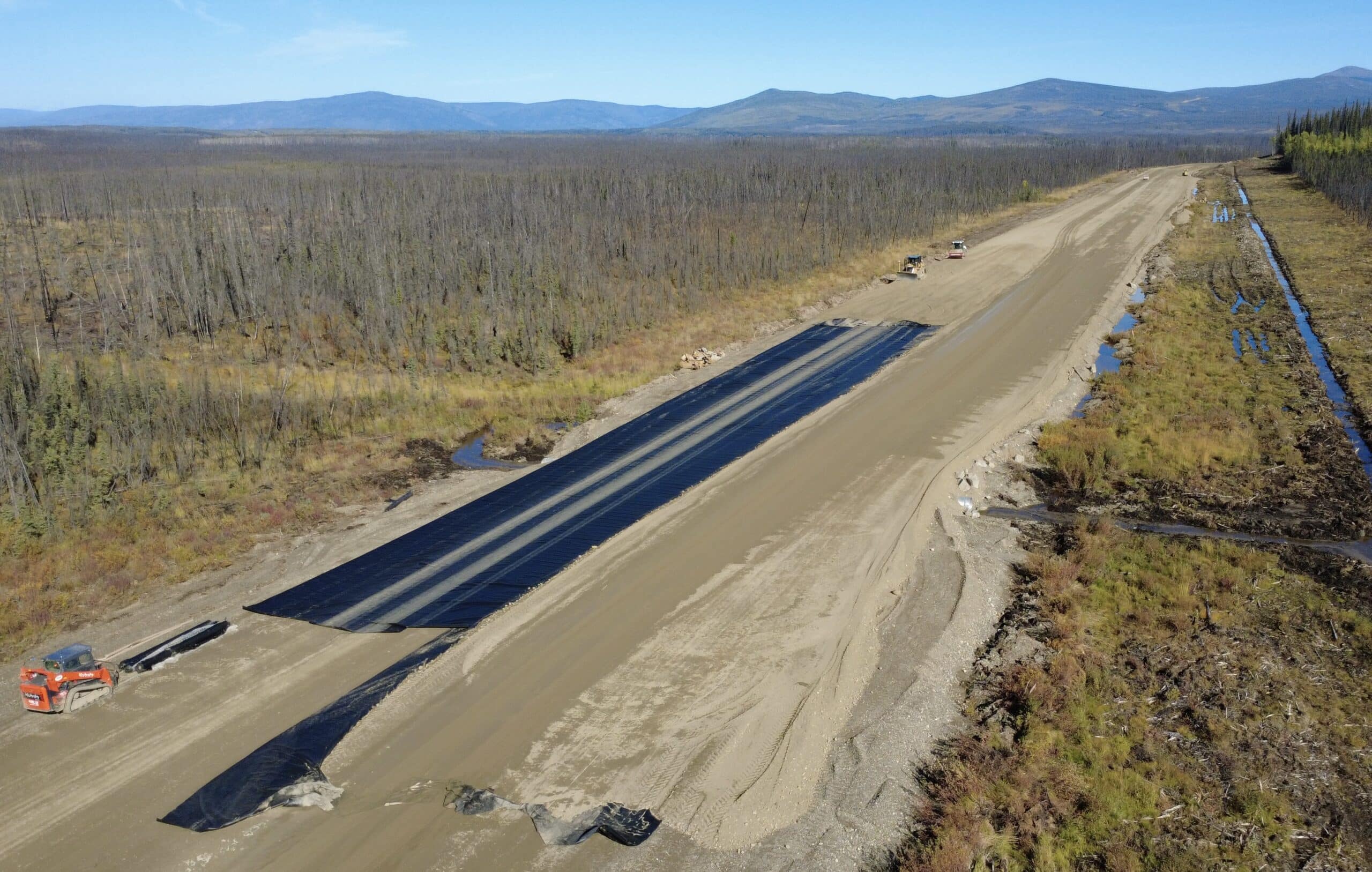
The Klondike Highway #2 rehabilitation project demonstrates how AIL’s high-performance woven geotextile can support transportation infrastructure built over difficult ground conditions. By reinforcing the embankments, the product helped mitigate the effects of differential settlement and improve load distribution, contributing to a cost-effective roadway solution designed to support long-term performance and reliable travel along this important northern highway corridor.